Water Research · 2026
Explainable simulation-to-field transfer learning for transient-based leak detection in water distribution networks
Dongyu Han, Oussama Choura, Muhammad Waqar, Moez Louati, Dai Linhan & Mohamed Salah Ghidaoui
Read the paperDongyu “Don” Han / Research engineer
A rapid valve closure launches a transient pressure wave through the pipes. We record the resulting pressure response at only a handful of sensors. My research asks what those signals can reveal about a leak—and where we should measure them.
The challenge
A leak can change how transient pressure waves reflect and scatter through the pipes. But labeled field measurements are scarce, and every additional sensor costs money and effort. That leads to two connected questions: how can a model learn from limited measured responses, and where should we place the sensors?
01 Learn across the gap
We can simulate many leak scenarios, but collect only a small number of labeled transient pressure responses in the field. Simulations give a model a starting point; measured responses let us test and adapt it to the physical network.
I fine-tuned models trained on simulated transients using limited experimental measurements. I then used Integrated Gradients to inspect which sensor–time regions contributed most to their predictions.
Transfer learning · Interpretable leak diagnosisCan features learned from simulated transients still help when the model meets measured responses?
Transformer model · 17 experimental scenarios
Mean absolute error on this evaluation; lower is better. These are best-model results, not a general field-performance guarantee.
02 Choose where to measure
Even a strong model is limited by what its sensors record. In a larger network, adding sensors at every node is impractical; each location has to earn its place.
I built a method that learns which subset of locations is most useful for distinguishing leak events. The network below shows the branches and nodes; the changing selection probabilities show the model making that choice during training.
Contrastive learning · Sensor selection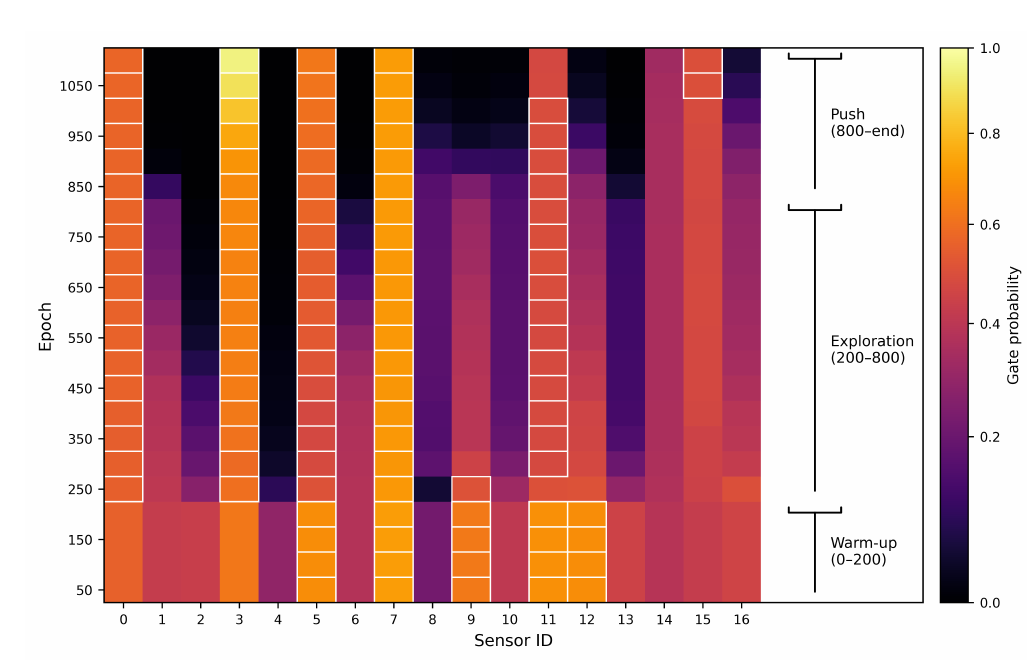
One simulated Q‑Leak setting · 8 sensors · SNR = 0 dB
At some lower-SNR, tighter-budget settings, the MI/MaxDet baseline performs better. This comparison uses simulated responses, not field measurements.
Publication
The simulation-to-field study is published in Water Research. If you want the methods, assumptions, and full results, start here.
Water Research · 2026
Dongyu Han, Oussama Choura, Muhammad Waqar, Moez Louati, Dai Linhan & Mohamed Salah Ghidaoui
Read the paperExperience
Hyele Limited · Hong Kong Science Park
Develop machine-learning algorithms for real-time pipeline condition assessment, from transient-signal processing and model validation to neural-network inference and sensor optimization.
HKUST · Civil and Environmental Engineering
Built reproducible simulation-to-field experiments for leak diagnosis and a contrastive, differentiable framework for sparse sensor selection.
Yuzhi Tech Co., Ltd. · Beijing
Built Java/Spring Boot services and integrated ML inference into a production digital-human system; contributed to a secondary-market knowledge graph project.
Independent project
A web app for exploring research papers. Upload a PDF, ask a question, inspect the source passages behind the answer, and browse the paper’s extracted relationships.
Explore EvidenceGraph